In 1953, Cambodia gained independence after nearly 100 years under French rule. During the 1960's, Cambodia was predominantly a Buddhist country under the rule of a monarch, Prince Sihanouk. In 1970, Prince Sihanouk was deposed in a military coup and Cambodia fell under a new leader by the name of lieutenant-general Lon Nol. After he was deposed, Prince Sihanouk joined forces with a communist guerrilla organization that was founded in 1960, known as the Khmer Rogue. In 1970, The Khmer Rogue attacked Lon Nol's army and a civil war began in Cambodia.
In 1970 when the civil war broke out in Cambodia, the Khmer Rogue guerrilla movement, under the leadership of Pol Pot was small, but by 1975 it is estimated that it had a force of over 700,000 men. On 17th April 1975, the Khmer Rogue captured Phnom Penh and Lon Nol was defeated.
Under Pol Pot's rule and within days of overtaking the government, the Khmer Rogue embarked on a mission to impose their extremist reforms on the people. These reforms included isolating the country from the outside world, abolishing all political and civil rights, closing all schools and hospitals, abolishing all currencies and the banking system, outlawing religion and confiscating all privately property. It has been said that the goal was to create a society that knew nothing and understood nothing. The Khmer Rogue's social reform plan was to create a purely agrarian-based communist society, where the whole population had to work on collective farms and on forced labour projects. Millions of people were forced from the cities to the countryside to work on these farms and projects. Those that resisted were killed. No one was spared the exodus, not even the ill, young or elderly (young children were separated from their parents and sent to forced labour camps for children). All the people working on these farms and labour camps became unpaid labourers, working for meager rations and for many hours a day. The conditions were so bad that many perished from starvation, exhaustion and illness.
Professionals, educated people (ironically Pol Pot himself was an educated man) and intellectuals, were singled out as they were seen to be a threat, as were people suspected of opposing the movement and people deemed to be elitists. These people and their extended families were simply murdered. In addition to eliminating anyone seen as a threat, so too was any un-communist aspect of traditional Cambodian society eliminated.
It is estimated that over 1.5 million people died at the hands of the Khmer Rogue (1/5 of the country's then population) from hunger, torture, starvation, sickness and exhaustion.
The Khmer Rogue was finally overthrown in 1979 when the Vietnamese invaded Cambodia. Although the Khmer Rogue continued to maintain power in some areas, it was only in 1999 that its final stronghold fell.
Pol Pot died in 1998 and never faced trial for his crimes against humanity.
There are two places in Phnom Penh that serve as a reminder of the pure evil that was committed against Cambodians and minorities under the Khmer Rogue : The Tuol Sleng Genocide Museum and The Killing Fields. Visiting the genocide museum and The Killing Fields was definitely something that we wanted to do while in Phnom Penh. Our reason for wanting to visit both these places was not due to any morbid curiosity, but rather to better understand what took place during this dark era in Cambodia's history and also to pay tribute to all those who lost their lives under Pol Pot's regime.
Today, Cambodia is a peaceful nation where democracy has been reinstated and where the main religion, Buddhism has been revived, but there is still a lot that needs to be done. Bill Clinton's UN Ambassador Richard Holbrook once said, "It will be a hundred years before Cambodia emerges from the horror of the Pol Pot Regime". We certainly hope he is wrong and that it will be a lot sooner.
***Warning - some of the images posted here may be disturbing, discretion advised***
Tuol Sleng Genocide Museum (S-21)
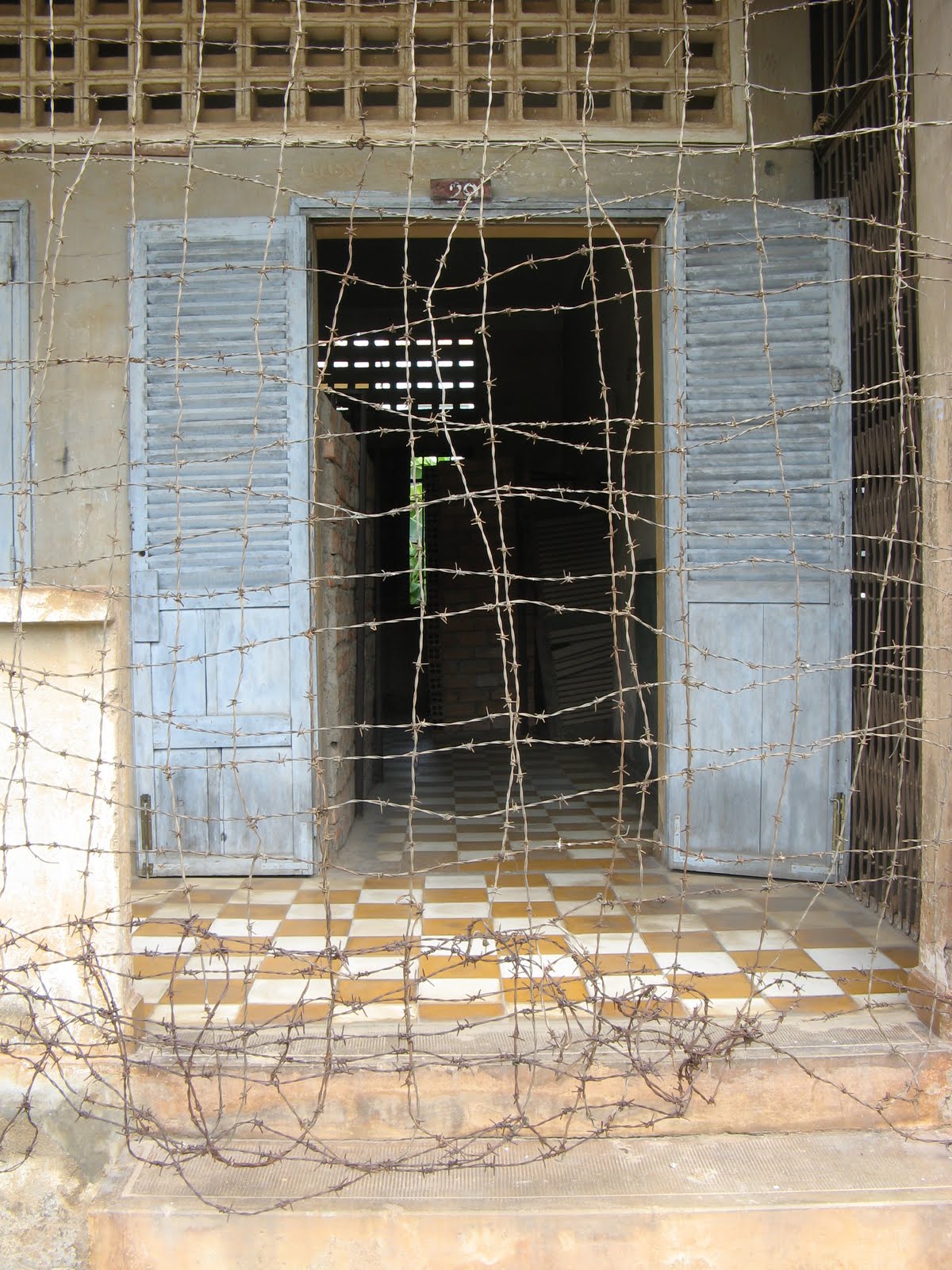
What was once a school filled with children, Tuol Sleng became one of the worst places to be in Phnom Penh from 1975 - 1979. In August 1975, on the orders of Pol Pot, Tuol Sleng was turned into a prison and was called S-21 (Security Office 21). The four buildings of the school were turned into torture chambers, large prison cells to house groups of detainees and tiny prison cells (measuring 0.8 x 2 metres each) for individual prisoners.
This prison was used for the detention, brutal interrogation, inhumane torture and sometimes the killing of detainees who were brought here (those who were not killed here were taken to The Killing Fields where they were executed). Most of the people (and their families) who were brought here, were people that the Khmer Rogue accused of opposing the Pol Pot regime.
In 1979 after the Pol Pot regime was overthrown, evidence from S-21 was collected and is now on display. Among the evidence collected are photographs of detainees, films, prisoner confessions, torture tools and shackles.
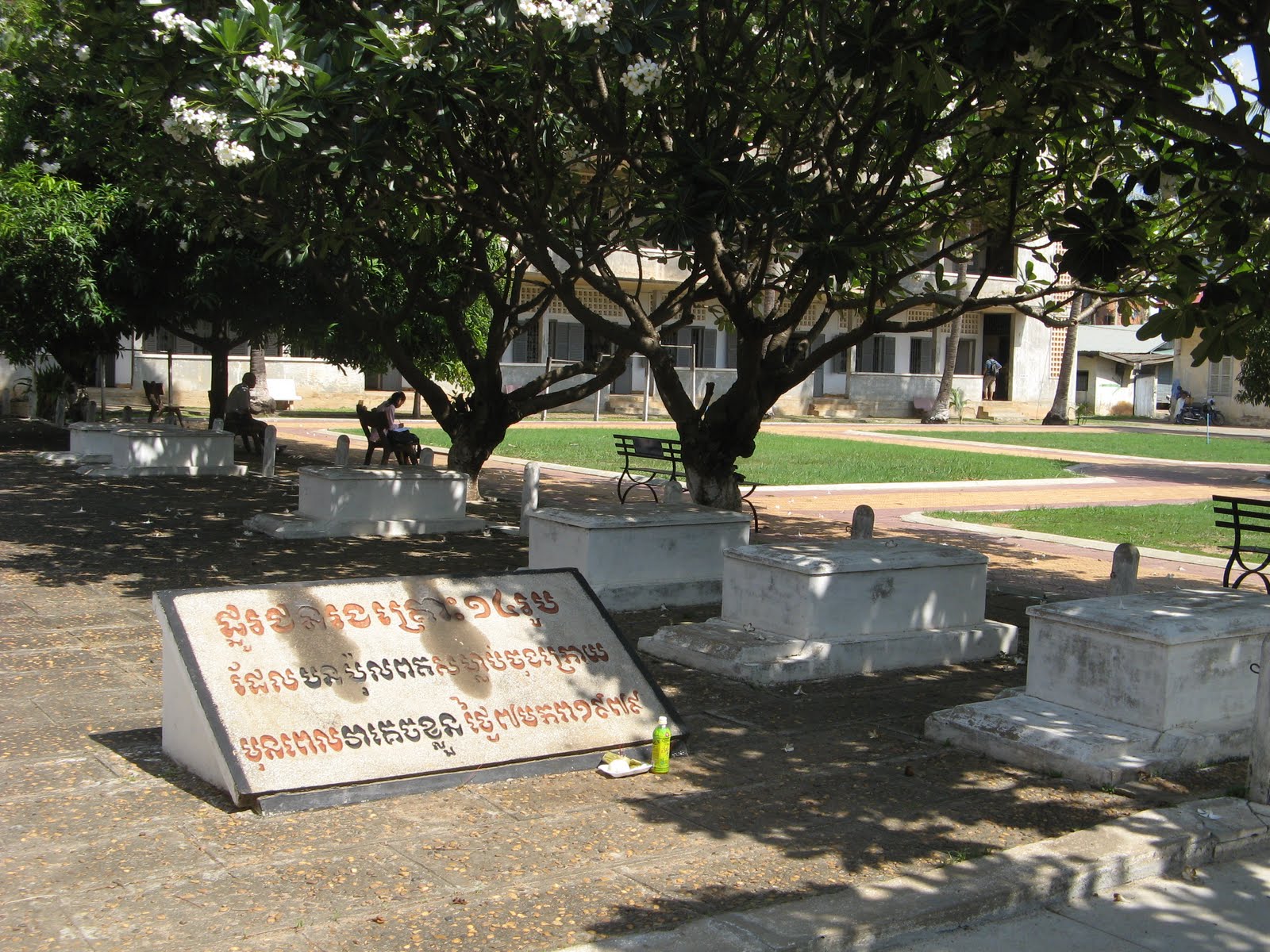
Based on records recovered, it is estimated that over 15,000 prisoners were brought to S-21 over the 4 year period that the Khmer Rogue was in power. The remains of 14 victim corpses (one of whom was female), were also uncovered and they have been laid to rest in front of one of the buildings of the prison. They are believed to have been the last people tortured and killed at S-21. Unfortunately they could not be identified due to bad decomposition.
Kang Keck lev (also known as "Duch"), was the Khmer Rogue leader that was in charge of running the S-21 prison. In 2007 Duch was formally charged with crimes against humanity and detained by Cambodia's United Nations-backed Cambodia Tribunal. He has since apologized and expressed remorse for his role in the torture and deaths of many people. He will be sentenced in July 2010.
Tuol Sleng is a sad and haunting place, especially seeing the photos of the thousands of men, women and children who were prisoners here, and who suffered unimaginable torture and ultimately death.





Choeung Ek (The Killing Fields)
There are many killing fields scattered all over Cambodia, but Choeung Ek is the most infamous of them all. Situated about 17 kms southwest of Phnom Penh, this was the execution site and dumping ground for thousands of men, women and children who perished under the Khmer Rogue in Phnom Penh. It is estimated that over 17,000 people were slaughtered and buried here in mass graves (8895 bodies have been discovered to date). Many were brought here after being interrogated and tortured at the S-21 Prison. One of the most disturbing facts is that many of the victims were women, children and even babies (there is a large tree on the grounds, that was used to kill babies by bashing their heads against the stump).
Today, Choeung Ek is a quiet and peaceful place, so it is hard to believe that this place was once a killing ground, but there are reminders everywhere of the atrocities that took place here. The most notable of these are the massive holes all over the grounds (mass graves) and the large white Buddhist stupa that stands in the middle of the grounds. This large monument was erected as a memorial to all those who perished and it holds thousands of skulls and bones that were uncovered in the mass graves. This is a sacred place, that hopefully will serve as a reminder that atrocities like this should never be allowed to happen again.


